Friday, June 18, 2021

Thinking Activity : An Artist of the Floating world

                                          Introduction

Sir Kazuo Ishiguro OBE FRSA FRSL is a British novelist, screenwriter, musician, and short-story writer. He was born in Nagasaki, Japan, and moved to Britain in 1960 when he was five. Ishiguro is one of the most celebrated contemporary fiction authors in English.


An Artist of the Floating World (1986)[1] is a novel by Nobel Prize-winning British author Kazuo Ishiguro. It is set in post-World War II Japan and is narrated by Masuji Ono, an ageing painter, who looks back on his life and how he has lived it. He notices how his once great reputation has faltered since the war and how attitudes towards him and his paintings have changed. The chief conflict deals with Ono's need to accept responsibility for his past actions, rendered politically suspect in the context of post-War Japan. The novel ends with the narrator expressing good will for the young white-collar workers on the streets at lunchbreak. The novel also deals with the role of people in a rapidly changing political environment and with the assumption and denial of guilt.


1. 'Lantern' appears 34 times in the novel. Even on the cover page, the image of lanterns is displayed. What is the significance of Lantern in the novel?
Lanterns are the symbol of the floating world. They represent the fleeting beauty and warmth of nightlife as well as the transience of the traditional way of life in Japan, which vanishes after the war. Lanterns are the old-fashioned, welcoming source of soft light at Mrs. Kawakami's. Within their spheres of light Masuji Ono is embraced. As a symbol of the floating world, lanterns often appear in Mori-san's work, either within the picture or as the implied light source for the subject in the painting. With the end of the war, the occupation, and the rapid modernization of Japan, traditional light sources like lanterns vanish just as the pleasure district and the floating world disappear when the sleek office buildings arise.

2. Write about 'Masuji Ono as an Unreliable Narrator'.
An Artist of the Floating World is a masterpiece that glides in out and of many dimensions. On the one hand, it is a story of generations separated by a massive ideological gulf. On the other, it is about an older man attempting to come to terms with his mistaken philosophies. It is also a historical fiction set in the Japan of limbos; Japan, which has suffered because of its misplaced imperialism, been shattered by bombings and is now critical of the past and every person representing it. At the heart of it is an unreliable narrator, Masuji Ono. Once an acclaimed painter, Ono is our guide through post-World War II Japan and its sociopolitical and emotional trauma; felt in extremities like the once-vibrant pleasure districts destroyed by bombings and kids who loved Popeye and Godzilla.
The book is a contemplative journey, spread across four time frames: October 1948, April 1949, November 1949 and June 1950. We are introduced to a retired artist of great acclaim, Masuji Ono. Ono lives with his youngest daughter Noriko, and his attempts to secure a good match for her is a central theme. In the past, Noriko’s engagement had been called off. While Ono likes to believe that his family was more powerful than the boy’s, Noriko’s often belligerent behaviour suggests the unsuccessful engagement has more to do with Ono’s past. His older daughter Setsuko asks Ono to meet his acquaintances and rectify his errors should Noriko’s prospects inquire about the family’s history. This simple task is the starting point of his recollections, opening twisted alleys of memory.
3. Debate on the Uses of Art / Artist (Five perspectives: 1. Art for the sake of art - aesthetic delight, 2. Art for Earning Money / Business purpose, 3. Art for Nationalism / Imperialism - Art for the propaganda of
 Government Power, 4. Art for the Poor / Marxism, and 5. No need of art and artist (Masuji's father's approach)
1. Art for the sake of art - aesthetic delight
     When summarized in this way, the novel sounds misleadingly like the depiction of a straightforward decline: as if Ono’s artistic ambition leads him first to aloof and implicitly elitist aestheticism, and then from aestheticism to overtly elitist fascism, as Walter Benjamin might have predicted:
“Fiat ars – pereat mundus”, says Fascism, and, as Marinetti admits, expects war to supply the artistic gratification of a sense perception that has been changed by technology. This is evidently the consummation of “l’art pour l’art.” Mankind, which in Homer’s time was an object of contemplation for the Olympian gods, now is one for itself. Its self-alienation has reached such a degree that it can experience its own destruction as an aesthetic pleasure of the first order. This is the situation of politics which Fascism is rendering aesthetic. Communism responds by politicizing art.
But Ishiguro’s novel tells a very different story, one consonant not with a Marxist critique like Benjamin’s but instead with the aestheticist philosophy of Wilde and his fin-de-siècle cohort. In this story, the aesthete becomes a totalitarian precisely because he abandons his apolitical outlook.

4. What is the relevance of this novel is our times?
Also, This Novel is relevance in our time  because we are already believe that The idea of Imperialism is depict by the writer through we can connect with current time. Also, According to countries people what's Nationalism? what do you believe if I know that there are so many soldiers, who will die for country. we can say that this is the true Nationalism but In my opinion like you can invent any new things from your own mind and gives for country so that's also Nationalism.
                                                        Thanks..😊


Thursday, June 17, 2021

Thinking Activity: 1984 by George Orwell

                          Introduction


Eric Arthur Blair, known by his pen name George Orwell, was an English essayist, journalist and critic. His work is characterized by lucid prose, biting social criticism, opposition to totalitarianism, and outspoken support of democratic socialism.

  
A Novel, often referred to as 1984, is a dystopian social science fiction novel by the English novelist George Orwell (the pen name of Eric Arthur Blair). It was published on 8 June 1949 by Secker & Warburg as Orwell's ninth and final book completed in his lifetime. Thematically, Nineteen Eighty-Four centers on the consequences of totalitarianism, mass surveillance, and repressive regimentation of persons and behaviours within society. Orwell, himself a democratic socialist, modelled the authoritarian government in the novel after Stalinist Russia. More broadly, the novel examines the role of truth and facts within politics and the ways in which they are manipulated.

1) What is dystopian fiction? Is '1984' dystopian fiction?

    In his dystopian science fiction, the citizens of Oceania are under complete control of the government. This dissertation asserts that Orwell’s characteristics of a totalitarian state such as surveillance, perpetual war and control over language and the media arepresent in modern democracies. If Orwell in his novel established the notion of surveillance state, then modern democracies are not trailing far behind. With Snowden’s revelations of extensive government surveillance programmes there is an eerie similarity between Orwell’s Big Brother and modern democratic governments. Similarly the perpetuity of war in Nineteen Eighty-Four can be identified in prolonged modern conflicts such as The War on Drugs, the Cold War and The War on Terror. The linguistic devices used in political language of Oceania to deceive its population resemble modern political phrases such as enhanced interrogation techniques, limited military operations, technical barriers etc. On the other hand, the fear of state controlled media is not a concern in modern democratic countries. However, as the analysis reveals, the modern media are not free from corporate monopoly and market forces.


2) What according to you in the central theme of this novel?

*Totalitarianism: Total Control, Pure Power*

The Party – the controller of the super state  “seeks power entirely for its own sake.” As an official admits: “We are not interested in the good of others; we are interested solely in power, pure power.”


*Propaganda Machines*
A well-organized and effective propaganda machine goes a long way in ensuring total control of the Party over the super state and its residents. The regulation and dissemination of information involves “tearing human minds to pieces and putting them together again in new shapes of your choosing.”


*The Thing Called Love*
The totalitarian knows that to rule people he needs to quell all ways of achieving happiness and fulfilment. Therefore, love and sex, two of the most enriching human experiences, are killed and depersonalized.

*Liberty and Censorship*
The Ministry of Truth works tirelessly and meticulously to modify public archives and rewrite history. As a result, “the past was erased, the erasure was forgotten, the lie became the truth.”

*Language: Doublethink and Newspeak*
The residents of the super state are forced to communicate in Newspeak – the government’s invented language. It plays a pertinent role in the Party’s control over the masses.

*Technology: All-seeing Telescreens and a Watchful Eye*
The Party needs and develops top-notch technology to exercise ruthless control over the residents. Without telescreens, the Thought Police would fail in its objective of surveillance. And, of course, overseeing all of this is Big Brother.

3) What do you understand by the term 'Orwellian'?
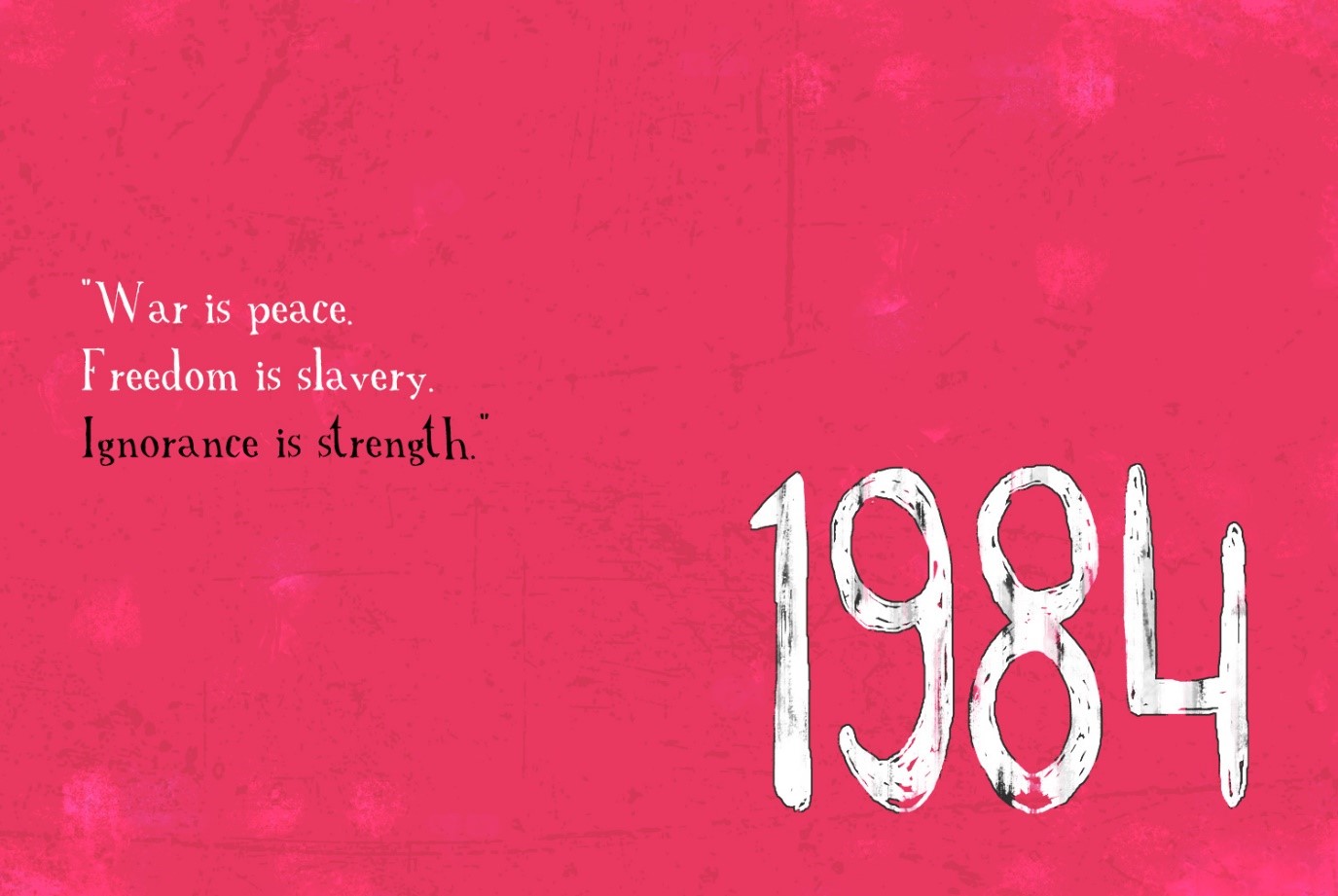
words have the power to shape thought. Language is the currency of politics, forming the basis of society from the most common, Everyday interactions to the highest ideals. Orwell urged us to protect our language because ultimately our ability to think and communicate clearly is what stands between us and a world where war is peace and freedom is slavery.
The Next time you here someone use of the word Orwellian, pay close attention. If they are talking about the deceptive and manipulative use of language, they are on the right track. if they talking about mass surveillance and intrusive government, They are describing something authoritarian but not necessarily Orwellian. And if they use it as an all purpose word for any ideas they dislike, It's possible their statements are more Orwellian than whatever it is they're criticizing.
                                      Thanks 😊


Wednesday, June 16, 2021

Thinking Activity: The Great Gasby

                    Introduction

The Great Gatsby, third novel by F. Scott Fitzgerald, published in 1925 by Charles Scribner’s Sons. Set in Jazz Age New York, the novel tells the tragic story of Jay Gatsby, a self-made millionaire, and his pursuit of Daisy Buchanan, a wealthy young woman whom he loved in his youth. Unsuccessful upon publication, the book is now considered a classic of American fiction and has often been called the Great American Novel.


1) How did the film capture the Jazz Age - the Roaring Twenties of the America in 1920s?

Jazz music became wildly popular in the “Roaring Twenties,” a decade that witnessed unprecedented economic growth and prosperity in the United States. Consumer culture flourished, with ever greater numbers of Americans purchasing automobiles, electrical appliances, and other widely available consumer products.

Technological innovations like the telephone and radio irrevocably altered the social lives of Americans while transforming the entertainment industry. Suddenly, musicians could create phonograph recordings of their compositions. For jazz music, which was improvisational, the development of phonograph technology was transformative. Whereas previously, music-lovers would actually have to attend a nightclub or concert venue to hear jazz, now they could listen on the radio or even purchase their favorite recordings for at-home listening.

2) How did the film help in understanding the characters of the novel?
The Great Gatsby's meditation on The American Dream—the idea that people are always reaching towards something greater than themselves that is just out of reach.
If we look at the idea of film that gives to us a proper Understanding of the Novel, also we can easily pick up the jay Gatsby example.

3) How did the film help in understanding the symbolic significance of 'The Valley of Ashes', 'The Eyes of Dr. T J Eckleberg' and 'The Green Light'?

The valley of ashes:  
 A symbolic place in the novel that first appears in chapter two. Nick goes there to search for his mistress. It is a place between East and West Egg created by dumping the industrial waste. It represents how morality and social code of conduct are dropped out of the industrial society. It also depicts the miserable plight of people like George Wilson who live among the ashes without ambition. This is a highly effective symbol that represents the divide between the poor and the rich class in the society of that time and even the present.


The Eyes of T. J. Eckleberg
 Another symbol we see in the novel is the eyes of T. J Eckleberg. These are faded bespectacled eyes printed on the billboard over the ‘valley of ashes’.  The eyes represent the commercialism which is the backbone of the American dream. It is clear from the fact of how Gatsby earns a lot of wealth to get Daisy back in life. These eyes also represent the hollowness and solidity in Gatsby’s eyes, for despite having all the glitters in life, his eyes reflect emptiness. To George Wilson, they are the eyes of God that watch over every segment of the society. To Nick, they represent the waste of past which sticks around, though, vanished.


The Green Light

The green light pops up many times in the novel and represents Gatsby’s dream and hope. It also represents everything that haunts him and takes him to the past. It also signifies the green stuff (money), his memories with Daisy and the gap between his past and his present. He deliberately chooses the house in a direction from where he can have the enchanting sight of green light. He loves to stand at the dock to stare at that green light which represents his innermost desire to revive his past. He is hopeful that one day he will win the lost moments. The artificial green light also stands for his artificial and unrealistic aims in life.

4) How did the film capture the theme of racism and sexism?
While in New York with Jay Gatsby, Tom’s opinion about race is revealed through his
speech with Daisy Buchanan; “Nowadays people begin by sneering at family life and family, institutions, and next they'll throw everything overboard and have intermarriage between black and white” . He disapproves of the intermarriage of races. Gatsby is “Mr Nobody from Nowhere”, and therefore, he constitutes a danger to the aristocracy . Even thoughGatsby acquired wealth, he is still inferior to the old money because of his poor background.

5) Watch the video on Nick Carraway and discuss him as a narrator.


Nick Carraway is The Great Gatsby's narrator, but he isn't the protagonist (main character).
This makes Nick himself somewhat tricky to observe, since we see the whole novel through his eyes. How can you watch the narrator? This difficulty is compounded by the fact that Nick is an unreliable narrator—basically, a narrator who doesn't always tell us the truth about what's happening.
He is a young man from Minnesota and a graduate from Yale who fought in the World War I. Then, he came to New York to indulge himself in bond business. He is generally quite reserved and honest. Nick is a confidant to Jay Gatsby, the central and most mysterious character of the novel who is full of troubling secrets. Being a friend of Gatsby, Nick gets a chance to peep into his soul and understand his love.
                                                    Thanks😊


Sunday, June 13, 2021

Thinking Activity: Archetypal Criticism

                        Hello Readers, 

     we all know that the Department of English is must be dependent on Thinking activity task. which things are always assigned by Dilip Barad. who is professor of english Department. So The student of Literature are always do some different task of they learn some thing new from the thinking activity.

           Archetypal Criticism


    Herman Northrop Frye (July 14, 1912 – January 23, 1991) was a Canadian literary critic and literary theorist, considered one of the most influential of the 20th century.

Frye gained international fame with his first book, Fearful Symmetry (1947), which led to the reinterpretation of the poetry of William Blake. His lasting reputation rests principally on the theory of literary criticism that he developed in Anatomy of Criticism (1957), one of the most important works of literary theory published in the twentieth century.

1.  What is Archetypal Criticism? What does the archetypal critic do?

 In literary criticism, the term archetype denotes recurrent narratives designs, patterns of action, character-types, themes, and images which are identifiable in a wide variety of works of literature, as well as in myths, dreams, and even social rituals. Such recurrent items are held to be the result of elemental and universal forms or patterns in the human psyche, whose effective embodiment in a literary work evokes a profound response from the attentive reader because he or she shares the psychic archetypes expressed by the author. Archetypal literary criticism's origins are rooted in two other academic disciplines, social anthropology and psychoanalysis; each contributed to literary criticism in separate ways, with the latter being a sub-branch of critical theory. Archetypal criticism was at its most popular in the 1940s and 1950s, largely due to the work of Canadian literary critic Northrop Frye. Though archetypal literary criticism is no longer widely Practised, or have there been any major developments in the field, it still has a place in the tradition of literary studies.

2.  What is Frye trying to prove by giving an analogy of ' Physics to Nature ' and ' Criticism to Literature ?
Northrop Frye has given a very unique idea of Archetypal Criticism by comparing the human emotions or human Characteristics with the cycle of seasons.

*Each season is aligned with a literary genre
  • Comedy with spring

  • Romance with Summer

  • Tragedy with Autumn

  • Satire with Winter

  •                  Spring

The spring season represents the Comedy. As per the genre of comedy is characterized by the birth of the hero, revival & resurrection. Spring also symbolizes the defeat of winter & darkness.
 
                                 Summer

The season of Summer indicates Romance because Summer is the culmination of life in the seasonal celendar, & the romance genre culminates with some short of triumph,usually marriage.

Autumn

Autumn season signify the genre of Tragedy. As the autumn is the dying stage of the seasonal calendar that's why the Autumn is parallels to the genre of Tragedy, because the genre of Tragedy is known for the fall on demise of the protagonist.

Winter 


The season of winter denotes the satire genre because of it's darkness. It's a disillusioned & mocking form of the three other genres. It is notes for its darkness, dissolution, the return of chaos & the defeat of heroic figure.

3) Share your views of Criticism as an organised body of knowledge. Mention relation of literature with history and philosophy.
    Criticism is as an organised body of knowledge. So it is progressive way of Literature. But Literature never organised it should free from it for the progress of Literature. It definitely deeply connected with the History and Philosophy both are important pillars  of Literature. The History connected with the myths and Philosophy connected with Morality and ethics. History stands for events and Philosophy is stands for idea.

4) Briefly explain inductive method with illustration of Shakespeare's Hamlet's Grave Digger's scene.

The best example of this method is grave digging scene from Hamlet, it is a specific scene and from that scene we come to know some general conclusion. In that scene there were two grave diggers and they seemed in quite in harmony with their work. They were talking with one another and singing a song during the time of grave digging. They were also mocking on dead Ophelia and commented that whether she allowed to buried or not. Here we can see that they have no grief for deadly one. It was their work and that's why they were habituated with it. It became their general work so they have no emotion for dead one.

5.  Briefly explain Deductive Method with reference to an analogy to music, painting, rhythm and pattern. Give an example of the outcome of the Deductive Method.
Deductive method is a journey from general to specific.Music and rhythm both are the form of art. Music is a form of art which moves in time and painting is a form of art which moves in space.Music is rhythm and painting is pattern. In a music we can understand the rhythm of it while in painting we can understand the pattern of it.Rhythm is a narrative form,while pattern is simultaneous mental grasp of verbal structure and it has meaning and significance.It provides a mental visual. By listening some of the music we can't get everything, but  by looking at painting we can get idea of it's pattern.

6) Refer to the Indian seasonal grid (below). If you can, please read small Gujarati or Hindi or English poem from the archetypal approach and apply Indian seasonal grid in the interpretation.

When , I was in third standard at that time, This poem taught by My primary teacher.

                                                               Thanks


Thinking activity : Waiting for Godot

                      Hello Readers,

As we know that the Waiting for Godot is one of the play by Samuel Beckett.  This is our thinking activity task is given by Dilip Barad sir. who is professor of Maharaja Krishna Kumar sinhji Bhavnagar University.

here, I would like to show you Dilip Barad's Blog.Click Here


1) What connection do you see in the setting (A country road, A tree, Evening) of the play and these paintings?


The setting of the play is inspired by two paintings by Caspar David Friedrich. The title of this painting is 'longing', here longing means deep desire for something. Waiting is connected with longing. In the painting two person see towards sunrise and sunset, it stand for bright hope and despair and in the play we find similar things.

If we can ponder These beautiful paintings through the idea comes to mind there is hope in this frame. The play by characters are waiting for Existence of Godot. They both are Example: Like we know that the sun is symbolically present some hope, desires kind of things in every human's Life.

2) The tree is the only important ‘thing’ in the setting. What is the importance of trees in both acts? Why does Beckett grow a few leaves in Act II on the barren tree - The tree has four or five leaves - ?


we can look at Tree has four Or five Leaves. The ponder upon this frame to have some Hope & Despair in the play. Also, Vladimir and  Estragon both are finding the character of Godot that we know that Godot will never come but some leaf through there are several chances to Godot will come. So Leaves are symbolically use by writer.

3) In both Acts, evening falls into night and moon rises. How would you like to interpret this ‘coming of night and moon’ when actually they are waiting for Godot?


we see that there is darkness of the Moon. It means today's day has been gone but people are just waiting again again. Actually, they don't have any proof that this day will be different than another days because they just dependent on other.

Example: Father has desire to give more education or Importance to Boy than the Girl. Why? Why As compare to Girls every one wants to Boy child?

Reason is that the Boy will have hope to give some money to his father. who has hope and second point is to be that the girl will be marry to some one and go from the house. it will depict the ill mentality of the society's people. But what I want to say that According to people Girl is Darkness and Boy is Moon as we know very well. The darkness will go and moon means There is more hope through the next sunshine will be different. According to character Godot will come like coming out moon and darkness will go at next morning.

4) The director feels the setting with some debris. Can you read any meaning in the contours of debris in the setting of the play?


look at the Frame, we can see that Existence kind of  Tree is  alive  but we see through the different triangle that There is Empty place, we can't accept here through we get some thing new but The main point ,which define that absurdity and Existentialism in the Play. The place is empty for that Godot will never come.

5) The play begins with the dialogue “Nothing to be done”. How does the theme of ‘nothingness’ recurs in the play?


The start of the play is Describe by the two Mans are talking with each other at that time one person Estragon says that there is meaningless nothing to be done. It's symbolize that we can do anything it is worthless, will not give benefit to us. Here is meaningless nothing to be done.

Example: we have seen many kind of person, who are just preparing for Government exam but the exam will never come or It has few chances of  clear that exam. so it will be like nothing to be done means meaningless. Like There are so many person who are waiting for Godot with The identity of fate through the meaningless character. Like we have Vladimir and Estragon.

6) Do you agree: “The play (Waiting for Godot), we agreed, was a positive play, not negative, not pessimistic. As I saw it, with my blood and skin and eyes, the philosophy is: 'No matter what— atom bombs, hydrogen bombs, anything—life goes on. You can kill yourself, but you can't kill life." (E.G. Marshall who played Vladimir in the original Broadway production 1950s)?

"The subject of the play is not Godot but waiting, the act of waiting is an essential and characteristic aspect of the human condition."

                                                        (Martin Esslin)

If we see this through the essay occurs that the waiting is more than the Godot. These are the some critical views but I'm sure and agree with this idea that this is the positive play rather than negative, Like both characters have hope from the waiting to something will come also Martin Esslin's point of view aspect is more and important characteristics of the play.

Example: Every humans have hope & despair,  To get or learning something new because of still They are waiting.

7) How are the props like hat and boots used in the play? What is the symbolic significance of these props?


Here are to symbols that significance of Body and mind. The body is represented the Boot and hat is symbolize mind that we can see it.

8) Who according to you is Godot? God? An object of desire? Death? Goal? Success? Or  . . .

According to me Godot is like fate and expectation that the some one will come and solve the own problems. Every human have desire to achieve some thing in his/her life but mostly dependent on divine power so here in this play Vladimir and Estragon have desire to prevention of his problems. so They are just waiting for Godot and doing meaningless activity. 

These are my own point of view to share with you..

*The Godot is desire of death through the  meaningless.

*The divined desires is the reason of the death.

*To be believe without proof it is meaningless.

*Expectation must be dependent on self but follow the ourselves.

                                                          Thanks😊


Saturday, May 29, 2021

Harold Pinter's ''The Birthday Party'' as comedy of Menace

             Name - Jignesh  K. Panchasara

 Paper - 110A: History of English Literature –                                                    From 1900 to 2000

             Roll No- 8

             Enrollment no-3069206420200013

Email id-jigneshpanchasara5758@gmail.com

             Batch- MA 2020-2022

Submitted to - S.B Gardi Department of English, Maharaja Krishnakumarsinhji  

                             Bhavnagar University.  

                Introduction 

The phrase “comedy of menace” as a standalone description inspires both positive and negative feelings. Comedy is used during a dangerous situation to cause audiences to draw judgments about a particular character or communication. The words used are the focus of often powerful stories that create conflicting emotions from its audience. The title “Comedy of Menace” immediately brings contradictions to mind, because comedy is generally something that makes people laugh, and the word "menace" implies something threatening. Quite literally, then, this phrase involves laughing at an ominous situation.

This phrase is part of the title of a British play called The Lunatic View: a Comedy of Menace, by David Campton. Irving Ward, a critic in the 1950s, emphasized the phrase when writing a review of the plays of Harold Pinter. Ward used "comedy of menace" in a review of several of Pinter's works, although at the time he had seen only one, The Birthday Party.


Comedy of menace has been started by David Campton. In English literature we can find out literatures like Neo-classical age, Victorian age, Romantic age, etc. But Harold Pinter criticizes some important political, economical system of England. Now days it became more critical because there is all around the world we can find out corruption anywhere, and it is leading by noble people unknowingly. However they are also an important part of the nation. Super nations have the concept of civilization, privatization and liberalization in the nineteenth century.

               Comedy = Humor.

               Menace = Threatening fear in mind.

      A work of art of a play in which people feels fear or the situation may become so much threatening that people or audience who watches the play may don’t know that what is happening and why it falls under the category of terrific matter. ‘Comedy of Menace’ is much different from sentimental comedy and anti-sentimental comedy. Comedy of menace is the phrase which was the part of the book “The Lunatic View: A Comedy of Menace”, which was written by David Campton. Irving Ward- a critic who quotes that In Harold Pinter’s play “The Birthday Party” has the effect of menace.

       From the very beginning till the end of the drama, there is lots of conversation between the characters like Mag, Nat Goldberg, Dermont McCann and Petey where Stanley stands for some countries which are silent or their voices are much damned, so that they could not argue against powerful nations like US, Germany, etc.

    In ‘Comedy of Menace’ there was another more distinguished interpretation is when counter-argue between two characters takes place, there it creates a kind of mental depression and we can’t say that we can make our self enjoying in that situation. If we talk about conversation then we must look at the facial expression as well as a thought process.

   As a playwright, Harold Pinter is an innovator of a new kind of drama which becomes famous as the Comedy of Menace. Unlike Coleridge, the famous Romantic poet, Harold Pinter begins his plays in our known, familiar world but gradually makes us move into the trajectory and psychodynamics of a world which is beyond our comprehension. In Pinter's Comedy of Menace, the laughter and elation of the audience in the same or all situations are immediately followed by a feeling of some impending disaster. An audience is, therefore, made aware, in the very midst of his laughter of some menace. The feelings of insecurity and uncertainty throughout the play also enhance the menacing atmosphere of Pinter's The Birthday Party. The menace in Pinterian drama is also produced by potential or actual violence or from an underlined sense of violence throughout the play. Pinter makes the audience feel that the security of the principal character (Stanley) and even the audiences' own security are threatened by some sort of impending danger or disaster. Actually the term 'Comedy of Menace' was first coined by David Campton who used the phrase as a subtitle of his four short plays The Lunatic View, published in 1957. However, in Pinter's hand, the concept of menace becomes highly symbolic and vague.

           Pinter's The Birthday Party is a perfect example of Comedy of Menace. Throughout the play, we find that the hint of menace is inflected upon the individual freedom of a person and it juxtaposes the comic element drastically dilutes the comic appeal. Pinter shows his state in the existential view that danger prevails everywhere and life can't escape from it. Pinter thinks that Stanley, the protagonist, might have committed a serious crime and is on the run for escaping the consequence and legal implications of his life. This is precisely comprehended while he almost never leaves his room and becomes furiously apprehensive when Meg informs him that two gentlemen are coming to stay in this boarding house. Stanley soon tactfully tries to conceal his apprehension by mentioning his successful concert and about a favourable job proposal of a pianist. But we can realize his innate apprehension for imminent interrogation or arrest by the two new guests at the boarding house:

 They won't come. Someone's taking the Michael. Forget all about it.

[Act - I]


In his attempt to percolate his fear upon Meg, Stanley informs her ironically that some people would come to the boarding house in a van along with a wheelbarrow and take away Meg permanently along with them: 

 They're looking for someone. A certain person.

[Act - I]

        In a mood of topsy-turvy-dom, Pinter often shows an apparent fearful apprehension, but actually gives occasion to amusement. Lulu's arrival and knocking at their boarding's door fulfil the purpose. Similarly, Meg's funny answer to Goldberg's question about Stanley also sustains the suspense of Stanley's immediate arrest. Thus, the dramatist gives a comic relief to his audience.

When Goldberg continuously refers to the "job" which he has to execute, makes an audience conscious about their unknown job, so as to say, by enhancing menace. Again the conversations between Goldberg and McCann are often comical but the possibility  of danger and violence always pervade above the comedy: 

 Goldberg: But why is it that before you do a job you're all over the place, and when you're doing the job you're as cool as a whistle?

[Act - I]

 Goldberg: You know what I said when this job came up. I mean naturally they approached me to take care of it. And you know who I asked for?

McCann: Who? 

Goldberg: You.

[Act - I]

The interrogation of Stanley by the "two gentlemen" is sometimes funny or comical but have threatening impact both upon Stanley and the audience. Even the birthday party which begins in a light and jovial manner ends with Stanley's attempt to strangle Meg and rape Lulu. Similarly, the birthday party also becomes the excuse of Goldberg's seduction and deflowering Lulu. Again the arrangement of the birthday party acts as a plan to prove Stanley lunatic and takes him away from the boarding:

 Goldberg: ...All is dependent on the attitude of our subject. At all events, McCann, I can assure you that the assignment will be carried out and the mission accomplished with no excessive aggravation to you or myself.

[Act - I]

At the end of the play, audiences are given an unsolved riddle about what has been of Stanley which is of paramount significance in Harold Pinter's The Birthday Party - a perfect example of Comedy of Menace. Some critics even believe that it is a superimposition of the European concept of absurd (Martin Esslin has been described the drama as an example of the Theatre of the Absurd) to the English native wit. Here what is true or what is false, is not matter but the ambience which Pinter clarifies as his concept of menace: '...menace and fear do not come from extraordinary sinister people but from you and me; it is all a matter of circumstances.

 Conclusion

The Birthday party is one of the comedy of Menace play because some events like a game ,door's Knocking in the darkness., and Lulu and mag's giggling with sounds like witch's laugh. so It depicts the menace effect in the play.

works cited 

Develop English Literature Knowledge. 2021. Harold Printer's 'The Birthday Party' as a Comedy of Menace | Comedy of Menace in Pinterian Drama. [online] Available at: <https://whichihaveacquired.blogspot.com/2018/07/printers-birthday-party-as-comedy-of.html> [Accessed 29 May 2021].

Info Bloom. 2021. What Is Comedy of Menace? (with pictures). [online] Available at: <https://www.infobloom.com/what-is-comedy-of-menace.htm> [Accessed 29 May 2021].

profile, V., 2021. Comedy of menace. [online] Engliteratureforall.blogspot.com. Available at: <http://engliteratureforall.blogspot.com/2015/11/comedy-of-menace.html> [Accessed 29 May 2021].

                                                             Thanks😊

The Feminism aspects of Virginia Woolf's Life and her Novels

                 Name - Jignesh  K. Panchasara

          Paper - 106: The Twentieth Century Literature: 1900 to World War II

             Roll No- 8

             Enrollment no-3069206420200013

Email id-jigneshpanchasara5758@gmail.com

             Batch- MA 2020-2022

Submitted to - S.B Gardi Department of English, Maharaja Krishnakumarsinhji  

                                 Bhavnagar University. 


                          Introduction

 Woolf was born Adeline Virginia Stephen on January 25, 1882, in London. Her parents were Leslie Stephen editor of the Dictionary of National Biography and Julia Prinsep Jackson Duckworth Stephen. Both parents had been married before and had children from those unions. Together, the Stephens had three other children in addition to Virginia Woolf was educated at home where she had free access to her father's extensive library. In 1895 her mother died, and Woolf experienced the first of many psychological breakdowns that would plague her throughout her life.

Virginia Woolf (1882-1941) was one of the most important female authors in the transitional period from Victorian age to the Edwardian age. Until her death at the age of 59 she published several novels, feminist essays and held two classes in Cambridge about “Women and Fiction”.

In this ,I would like to introduce the feminism aspects of her life and novels.

After giving a short introduction with the most important facts about Virginia Woolf’s life, my first intention is to define the theory of feminism and show how it affected Virginia already as a young girl and mainly as an independent woman.

Later, three of her novels are taken to demonstrate how Virginia Woolf’s development influenced her literary output. I would also like to show the differences between Virginia Woolf’s attitude towards women and men and compare it to theories of the feministic movement in the 20th century.


** A short introduction into Virginia Woolf’s life**
Born as the third child of Sir Leslie Stephen, the editor of the “Dictionary of National Biography”, and his second wife Julia Duckworth, January 1st 1882, Virginia and her siblings grew up in London where she had always had easy access to education, such as private classes in Latin and Greek - which was not a common case for girls in Victorian times - and also to her father’s library.

There were two major incidents in Virginia’s youth that caused serious mental breakdowns: Her mother’s death in 1895 and seven years later, her father’s death of cancer.[1] After recovering from this mental crisis, Virginia enjoyed her new independence, travelling to Spain and Italy, accompanied by her sister Vanessa and her brother Thoby, who later died of Typhus.

Virginia returned to London where she made friends with Leonard Woolf. After getting married in 1912, Leonard had to find out that Virginia not only refused any sexual relationship with him, but also had numerous breakdowns during the following years, including several tries of committing suicide. This mental illness carried on during her whole life, usually appearing shortly before finishing her most recent novel.

** Definition of the  “Feminism”**
To analyse Virginia Woolf’s attitude towards feminism and how this is demonstrated in her books and essays, there has to be a definition first of what “feminism” means in general: Feminism is “the belief in the principle that women should have the same rights and opportunities as men” also “the movement in support of this” But there are also different types of feminism, such as the “cultural feminism”, the “Individualist or Libertarian Feminism”, the “Moderate Feminism” and several more. What they all have in common is that they have the same origin which is to call attention to the problem of discrimination between men an women concerning different issues, social and private.

The feminism movement started already in the 19th century although it did not develop as fast as in the beginning of the 20th century when the female presence in public, work-life and also in the media at that time was accepted.

The media and female writers were the main supporters of the feministic movement, that achieved and changed a lot, but still has not reached his goal, for it still works with the same principles such as for example the “Emma”.

**How the theory of Feminism influenced Virginia as an adolescent**
The relationship between her parents, the talented and highly respected Leslie Stephen and his beautiful wife, who was always there to give him support and her unshared attention, had great effect on Virginia’s attitude towards men. It is said that she inherited her mother’s beauty but that she could not deal with it the way her mother did. She regarded her mothers ability to get along with other people so well with great approval but she could not cope with her mother’s behaviour as it was appropriate for a woman in Victorian times – a role her mother fit perfectly in. After her mother died in 1895 at the age of 49, Leslie Stephen tried to force his daughters into the empty space the mother left as being a perfect hostess, which made them fear and hate their father, and which had also a great effect on Virginia striving for a way out of this Victorian tradition.

Another influence in her development towards an important author of modern feminism were her two step-brothers, George and Gerald Duckworth, but also her own brothers, Thoby and Adrian, who enjoyed a full education at Cambridge University, while she stayed at home, taught by her parents and later receiving private classes, an untypical phenomenon in Victorian times, as already mentioned above.

The Famous Novels of Virginia, which differ The feminist Issues of the Woman.

  • A Room of One's Room

  • To The light House

  • Orlando 

  • Mrs. Dalloway

  • The voyage Out
 These are the famous Novels of Virginia Woolf. In that reading through we can get the idea of She was a FEMINIST.

Let's see The Feminist quotes by Virginia Woolf.
 

Woolf writes:

CLOTHES HAVE, THEY SAY, MORE IMPORTANT OFFICES THAN MERELY TO KEEP US WARM. THEY CHANGE OUR VIEW OF THE WORLD AND THE WORLD’S VIEW OF US.

 ORLANDO AS A PERSONIFICATION OF THE IDEAL STATUS OF ANDROGYNY; SOMEONE WHO KNOWS THE SECRETS OF BOTH SEXES AND CAN ACCESS THE WHOLE SPECTER OF HUMAN EXPERIENCE.

 The novel exuberantly conveys its message of the urge of gender equality in our society. Ergo, my feminist reading of Orlando salutes Woolf as an author, who so beautifully cultivates the fluid identities of the notions of sex and gender in her piece.

 ORLANDO IS NOT A WOMAN ACTING LIKE A MAN. ORLANDO IS A MAN. AND A WOMAN.  AND THERE IS NOTHING UNNATURAL ABOUT IT.

ORLANDO HAD BECOME A WOMAN THERE IS NO DENYING OF IT. BUT IN EVERY OTHER RESPECT, ORLANDO REMAINS PRECISELY AS HE HAD BEEN. THE CHANGE OF SEX, THOUGH IT ALTERED THEIR FUTURE, DID NOTHING WHATEVER TO ALTER THEIR IDENTITY.


When in Constantinople amongst the natives, Orlando did not experience gender differences due to her changed sex. However as soon as she boards the Enamoured Lady to return to England, appropriately dressed as a “young Englishwoman of high rank”, she realized that English “women are not  exquisitely apparelled by nature”.

Conclusion

If we see the character of Virginia Woolf. so we can get the idea of feminist woman of the 20th century. whose novel is to be the part of the feminist idea of woman . who are suffering  and fight for the rights, which are not found for the woman. Also, The Victorian age is one of the Example of it.

works cited

(Autor), E., 2021. GRIN - Virginia Woolf and feminism. [online] Grin.com. Available at: <https://www.grin.com/document/129571> [Accessed 26 May 2021].

Encyclopedia.com. 2021. Woolf, Virginia: Introduction | Encyclopedia.com. [online] Available at: <https://www.encyclopedia.com/social-sciences/encyclopedias-almanacs-transcripts-and-maps/woolf-virginia-introduction#:~:text=VIRGINIA%20WOOLF%3A%20INTRODUCTION,of%20One's%20Own%20(1929)> [Accessed 26 May 2021].

2021. [online] Available at: <http://feminismininhttpsdia.com/2015/07/31/feministic-reading-virginia-woolfs-orlando-biography/> [Accessed 26 May 2021].

                                                                  Thanks

Daily schedule Report Dated: 21/10/2024

  Daily schedule Report  Date: 21/10/2024  Monday  Hi! Good Morning Friends. By day, I would like to talk about my daily activities in...